
The first useful system is a route
The opening task has a clear beginning and end: collect water at the shore and deliver it to collection. Before it is a factory, it is a route you repeat on foot. That makes each mechanical addition easy to understand in terms of the work it replaces.
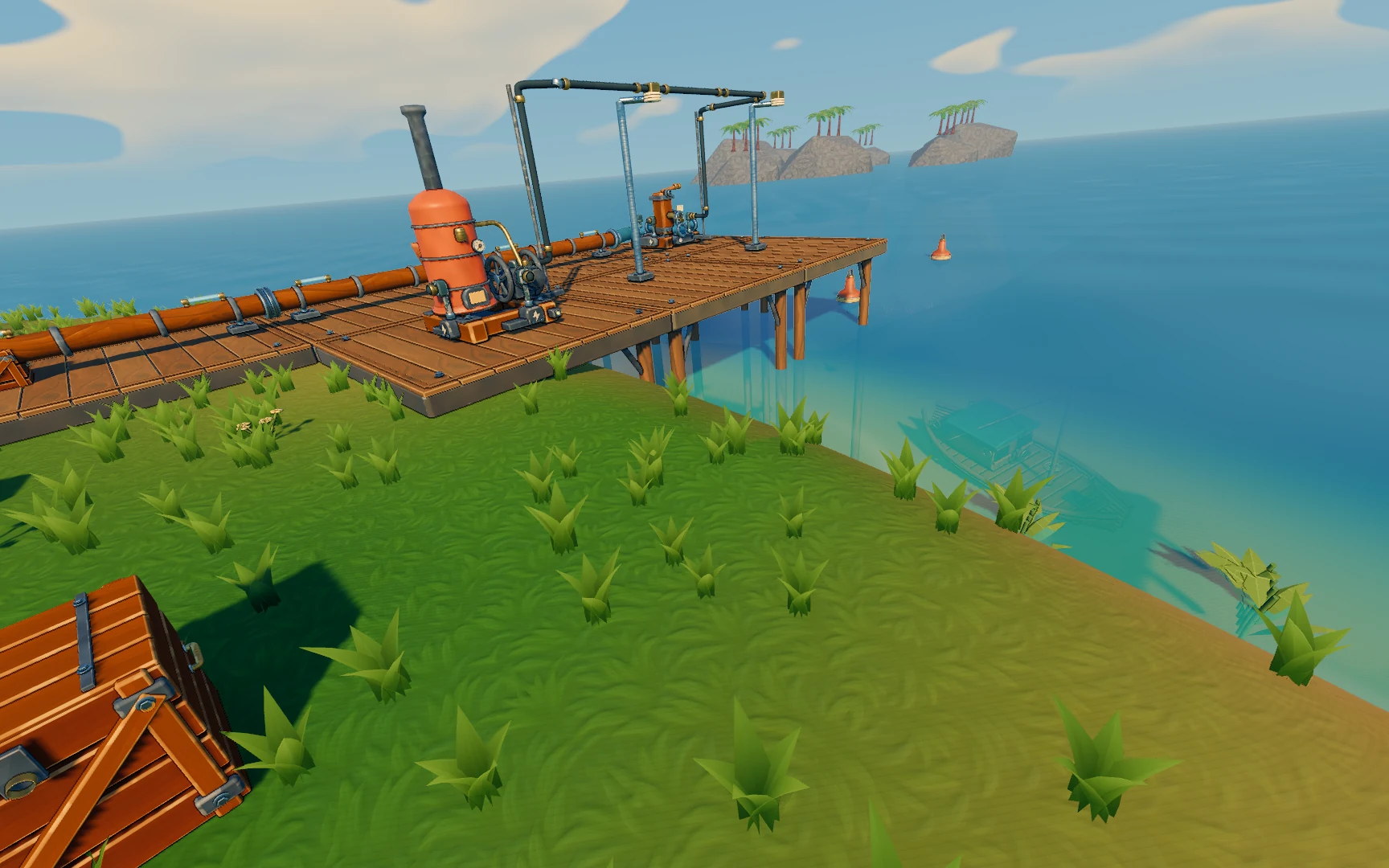
A hand pump provides an early step beyond carrying everything in a bucket. Water storage and connected lines create more options for moving the output. Later, powered equipment lets the operation continue while you attend to another part of the island.
The objective stays the same through that change. You are still trying to retrieve one lost shed key. The factory changes the amount of work you can do toward it.
Why does a water-search game need a sawmill?
Machinery needs construction materials. Timber can become planks, ore can become useful metal components, and manufactured parts support more capable equipment. Resource gathering and production give the factory a reason to have more than one type of building.
The sawmill is a concrete example. It turns timber into planks and also produces fuel. Those outputs have different jobs: planks help you build, while fuel supports processes that need it. The useful result is a small production chain you can follow from its source to its destination.
This also creates decisions about where your attention goes. You might gather a material yourself to finish one machine, or improve the production route that will supply several future projects. Both actions support the search, on different timescales.
Water, power and materials use different connections
A factory works through relationships between machines. A pump needs a valid water intake and a place for its output to go. Powered equipment needs enough electricity. Production buildings need their actual inputs and room for the results.
The connection types reflect those jobs. Water and gas have their own fluid lines. Cables carry power. Conveyors carry solid materials. Keeping those roles distinct makes it possible to trace a stopped process through the world instead of treating every connection as an interchangeable line.
For example, supplying a machine with power does not supply its timber. Adding timber does not clear a full output buffer. Completing a chain means making sure every required part of that chain can do its job.
A working chain is more useful than another idle machine
When progress slows, it is tempting to build another producer immediately. First check whether the producer you already have can run. Its panel can identify missing input, insufficient power or blocked output.
Follow the route in order: the resource source, the machine doing the work, the transport, and the place receiving the result. If one step has stopped, increasing capacity somewhere else may make little difference. Fixing that one step can put the whole route back to work.
Unplug the Ocean's machinery and transport can be upgraded, so expanding the footprint is not the only way to grow. Our guide to upgrades and bottlenecks explains how to judge what the factory needs next.
What does automation let you do next?
Once a route runs reliably, you have more freedom to explore the coast, investigate finds, or plan the next connection. The point of the automated system is that you can spend less time repeating the original carrying job.
The falling sea gives that growing operation a visible consequence. The island's surroundings change as the search advances, linking the factory you built to places you can visit. Read how ocean draining and the key search fit together for the wider loop.
The gameplay reel is a short look at the development build. Current release and storefront information is kept on the official facts page.